Skip Navigation

Posts
5
Comments
660
Joined
3 yr. ago

  • Grasshoppers liked my lettuce way too much. They can eat the plants outside of the net.

  • So how can people actually detect these watermarks, is it only accessible to the company that produced them?

  • LLMs cannot distinguish between recent and out-of-date information in the context, and information in the model itself, learned during training (“dominant priors”), can often “outweigh” information we give it

    LLM inference is more accurate when we give them examples (demonstrations) rather than just describing what we want.

    Deep neural networks, including LLMs, struggle to learn patterns with long-range dependencies, at any scale of model. They will always be “driving in fog”, with local, short-range probabilities crowding out long-range ones. In case you were wondering why they suck at the “big picture” – probabilistically, it’s a blur.

    I'd guess that what all this stuff adds up to is, sustainable use of LLMs as a coding tool for nontrivial projects calls for an entirely reworked set of software development practices to conform to its limitations effectively, but the people in charge really really want and believe it to be a drop-in efficiency boost, and a big mess results. This reminds me a lot of the articles and arguments I've read over the years about low level vs high level programming languages and frameworks. Probably will play out a similar way.

  • The research on the topic mostly concludes that giving homeless people housing is very effective.

  • also if you give stuff away for free, the market price would collapse. people would just wait to get it for free and then never buy the fresh product.

    Accessible media piracy has not caused people to stop paying for media. They buy new cars. They use meal delivery apps despite that they are many times more expensive than other ways of getting food. People would absolutely keep buying food even if they had the option to get everything they need at a food bank for free. The only effect might be somewhat reduced sales and lower profits, but there would still be a large consumer base that is willing to blow money on stuff like convenience and status.

  • When I was a teenager who had to get up for school my mother would do this and I had to tell her to stop because I started to genuinely loathe her singing, whatever noise gets picked for an alarm you're getting conditioned to have a negative reaction to

  • I'd believe it with evidence, but this would absolutely get coverage from real journalists if it was real and directly involved academic researchers and a government agency like claimed, and that coverage doesn't seem to exist.

  • Ugh, I don't even know anymore

  • Really ironic, what were they thinking?

  • Probably not, but it's interesting to think about the implications here. If the new you is the same except for the memories and experiences, then what you become is a function of your environment, and if enough experiments are run on this over successive generations then an accurate and comprehensive model of your behavior and thinking could be obtained.

    So I don't know if this has been done before but I have this idea for a fictional setting where there's people like this, who have made themselves this kind of immortal, and tried to set up automated systems to ensure they have some kind of continuity, raising themselves with robots, biometric access, keeping a journal and such. But then maybe the people excluded from these systems will have figured out over long periods of time that the immortals are predictable, since they are the same people repeated, and developed ritualistic cargo-cult-esque ways of interacting with them designed to produce the results they want, maybe even speaking words in a language they don't understand and just knowing that those particular words will be interpreted the right way because the person being spoken to has been a known quantity for centuries or millennia.

  • This makes much more sense thanks

  • Crazy that this guy was directly a victim of Flock and then completely lets them off the hook and gives the CEO a platform to spout propaganda.

  • I actually like it when games do that sort of thing, keeps you on your toes, shoutout to Backpack Battles

  • This is referenced in the alt text, I looked it up:

    https://finance.yahoo.com/news/sbf-dangerous-decision-making-philosophy-124600175.html

    Yet when asked exactly that in a March 2022 podcast with Tyler Cowen, Sam Bankman-Fried (SBF) was quite willing to play that game–and keep playing it, over and over again. Cowen asked SBF about the high likelihood of destroying everything by going double of nothing on a series of coin flips. SBF responded that he was willing to make this trade-off for the possibility of coin-flipping his way into "an enormously valuable existence."

    Fortunate that he went bust on only a few billion worth of stolen money and not the fate of humanity, though the same can't be said for the rest of the delusionally arrogant megalomaniacs running things

  • Imo in any situation where you are choosing risk/reward preferences it's important to consider how much different levels of reward will actually benefit your life. I think in most cases losing everything you own is going to be more bad than doubling your wealth is good, and so it's a bad idea to only consider the alpha of an investment. Or it could be the other way around, maybe someone desperately needs to escape their shitty job, so for them a very risky investment that actually has lower effective value than the safe investment is the more rational choice.

    Which isn't to say discount EV entirely, that's how you end up at bad decisions like buying a lottery ticket.

  • Comic Strips @lemmy.world

    Saturday Morning Breakfast Cereal - EV

  • Is it just me or is there no article at that url? Are we supposed to infer some kind of narrative from all the charts and stuff there?

  • I might try opencode, I just have not gotten it to work well yet to put together an overall understanding of a codebase, and guess that maybe it is more straightforward with whatever interface the author of this blog post is using, particularly with prompts like the one he mentions:

    look at the xfwm4 source in detail and determine everything there is to know about $FEATURE.

    tbf I only started looking into using agent frameworks and getting them to do this very recently and only tried a few, maybe it's doable, but what little I've tried did not work. Hermes running Qwen3.6 at 64k context, but many files in the codebase exceed that on their own, and that did not get handled gracefully.

  • Pretty levelheaded opinion, using it mostly for code analysis and review seems like a good idea. Personally I draw the line at using services like Claude, but I've been trying to do this kind of task with local models and haven't figured it out yet, run into issues with context limits. I like Xfce and will keep using it.

  • Of course some form of coordination is useful, but no single metric can handle that much pressure. It should be obvious by now that our society is relying too heavily on these credentials, and that they have become less useful to everyone because of that.

  • Comic Strips @lemmy.world

    Saturday Morning Breakfast Cereal - Gently...
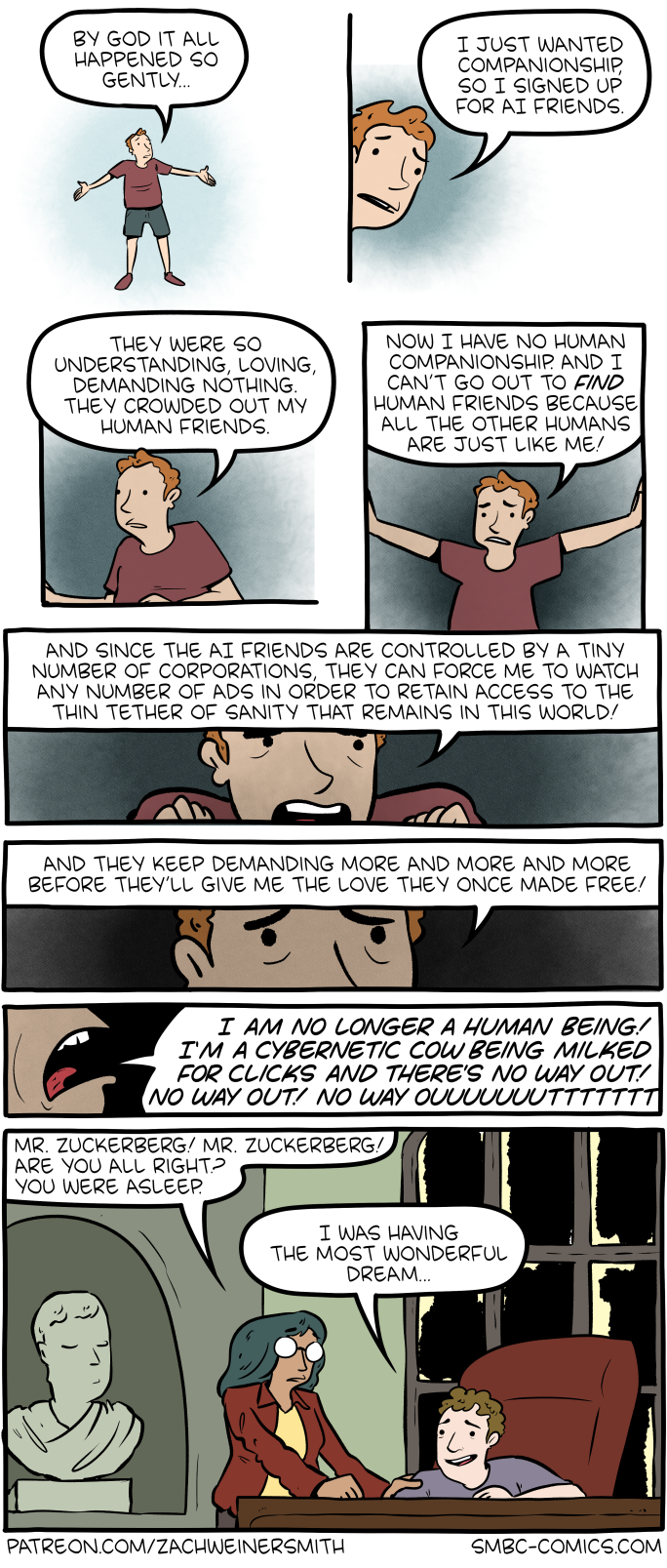
    www.smbc-comics.com /comic/gently
  • Comic Strips @lemmy.world

    Saturday Morning Breakfast Cereal - Yup

    www.smbc-comics.com /comic/yup
  • Comic Strips @lemmy.world

    Saturday Morning Breakfast Cereal - Elves

    www.smbc-comics.com /comic/elves
  • Comic Strips @lemmy.world

    Signal