Skip Navigation

InitialsDiceBearhttps://github.com/dicebear/dicebearhttps://creativecommons.org/publicdomain/zero/1.0/„Initials” (https://github.com/dicebear/dicebear) by „DiceBear”, licensed under „CC0 1.0” (https://creativecommons.org/publicdomain/zero/1.0/)B
Posts
9
Comments
743
Joined
3 yr. ago

  • Pre- and post-increment are only really useful when you're doing C-style looping and there's a good reason we don't do that in Rust.

    I actually honestly can't recall ever making an off by one error in Rust, I'm sure when implementing specific data structures or when doing pointer manipulation it's still a possibility but you can write a gazillion lines of code without ever running risk of that particular annoyance. Also while C folks may have an argument regarding operator semantics, C++ folks don't they're doing unspeakable things to <<.

    Also, FWIW Haskell uses ++ to append lists and therefore also strings. It's not like it's an odd-ball usage of the symbols, that'd be .. which I vaguely remember some language using. Would cause a whole new class of confusion regarding 'a'..'z' vs. "a".."z". Not to mention that "aa".."zz" actually makes sense as a range all that's missing is &str: Step. Probably not a good idea to have built-in because do we mean printable ASCII? Whole unicode range? Just the alphabet? Not an issue when you're doing it to single chars but strings get ambiguous fast. Does Rust even guarantee stuff about Char ordering C certainly doesn't really do that, short of I think 0..9 being contiguous.
  • Probably. Proxima fusion is using simulation-driven engineering to pave their way through the design space, no matter how you approach it it's gotta involve dimension reduction in some way and that's ML. They speak of AI but well it's a press piece.

    LLMs or diffusion models? Nah, don't think so. This is actual engineers throwing statistics at a particular problem to identify what prototypes they should build, not techbros throwing shit at the wall.

  • That's been the history of tokamaks because they're dealing with an inherently unstable situation. It's like balancing a ball on another ball, saying "yep ok I've figured that out", scaling it up and discovering that between those two balls were actually five other that now that the system is bigger have quite a relevant impact.

    Contrast with stellerators, which are more like balancing a ball in a bowl. Long considered impossible because the magnetic field just has a too complex geometry the Max Planck institute proved that they work as the theory says, and they're currently working on commercialisation.

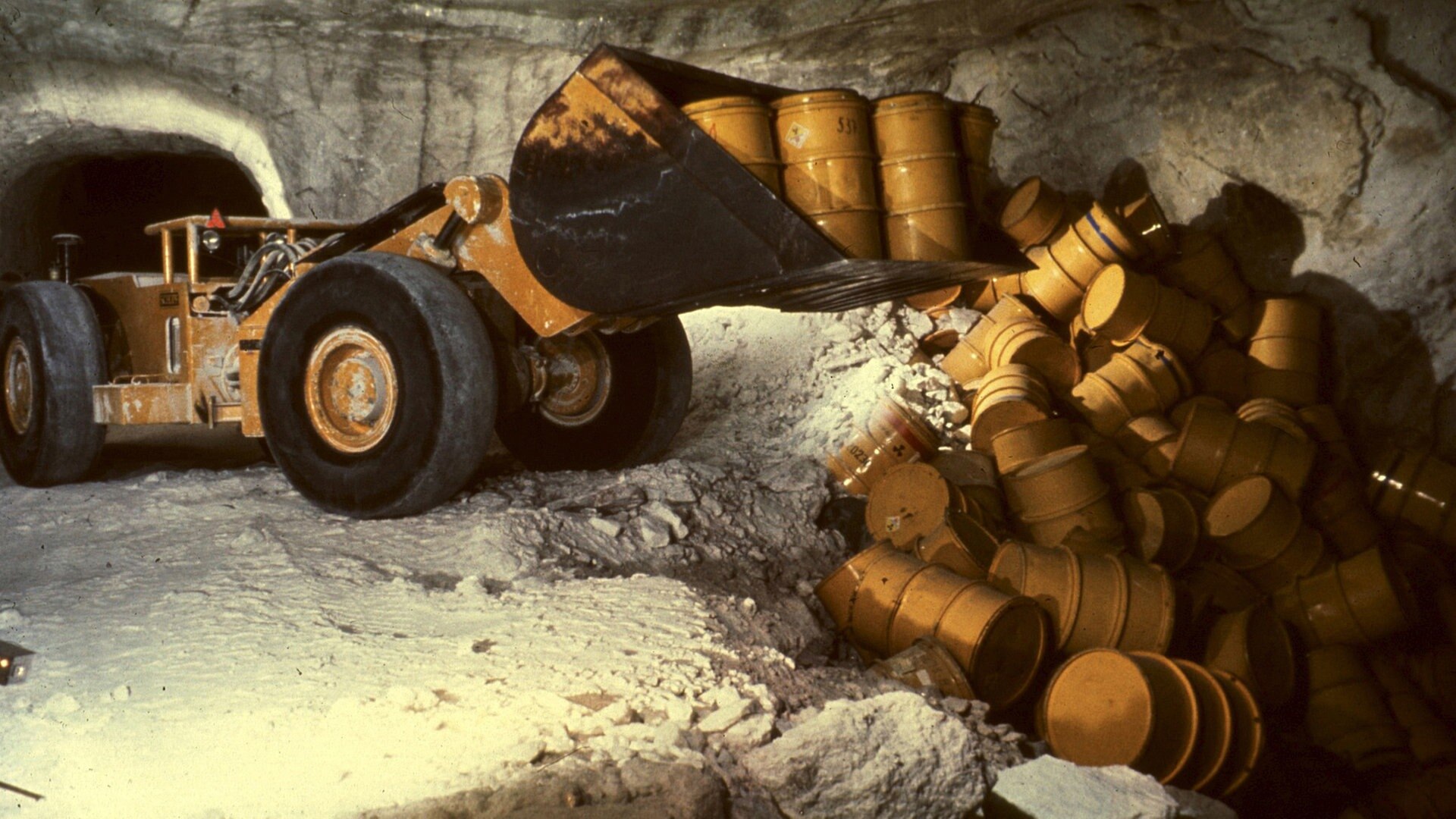
  • Maybe Tom Scott should make a video about the Asse salt mine. It's where the "yellow barrel == nuclear waste" meme comes from look here a picture.

    This stuff is the driving factor behind nuclear energy being a political no-go in Germany: We just don't trust anyone, including ourselves, to do it properly. Sufficiently failure-proof humans have yet to be invented. Then, aside from that: Fission is expensive AF, and that's before considering that they don't have to pay for their own insurance because no insurance company would take on the contract.

    Fusion OTOH has progressed to a point where it's actually around the corner, when the Max Planck institute is spinning out a company to commercialise it you know it's the real deal. And they did.

  • Rust has impl Add<&str> for String and impl AddAssign<&str> for String. Both append as expected.

    I wouldn't go so far and say "as expected": "Addition" implies that we're dealing with a ring, that there's also multiplication, and that really doesn't make sense for strings (unless you indeed consider them numbers). It's why Haskell's Monoid typeclass comes with the function mappend, not madd.

    In Rust's defence though std::ops traits aren't meant to carry any semantics they're about syntax: It's called Add because it's +, not because it means something. I do think it would've been worth it to introduce ++ for general appending (also vectors, sets, maps, etc), though, to keep things clean. Also ++= for the mutating case.

  • Does crates.io have a backup plan?

    Jump
  • Saint Helena is in no way comparable because it's not disputed territory. Back when Mauritius became independent the British carved out some islands for their continued colonial use, breaking (back then brand new) international law.

    Saint Helena has no such connection to another country and it was uninhabited before the Dutch settled. The Brits later conquered it but even if the Dutch want it back it'd keep its autonomous territory status and therefore its own TLD, the Dutch have plenty of those.

  • Does crates.io have a backup plan?

    Jump
  • Serbia isn't going to vanish any time soon.

  • Allowing limited liability companies to exist without requiring them to be covered by liability insurance is institutionalised market failure.

  • The string “AAAAA” cannot be said to be greater or less than “AAAAB”, besides the very special case when we order it.

    I hate it to break it to you but it's the same with numbers.

  • That makes complete sense. Ranges implement fmt::Debug, .. is a range, in particular the full range (all values) ..= isn't because the upper bound is missing but ..=.. ranges from the beginning to the... full range. Which doesn't make sense semantically but you can debug print it so add a couple more nested calls and you get a punch card.

    I totally didn't need the Rust playground to figure that out.

    EDIT: Oh, glossed over that: .. is only the full range if standing alone, it's also an infix operator which is why you can add as many as you want (be careful with whitespace, though). .. .. .. .. .. .. .. .. .. .. is a valid Rust expression.

  • Named function arguments would occasionally be nice to have instead of the single n-tuple they take now. Currently I'm more or less playing a game of "can I name my local variables such that rust-analyzer won't display the argument name when I stick them into functions (because they're called the same)).

  • Enum constructors are functions, this typechecks:

     rust
        
    fn foo<T>() {
        let f: fn(T) -> Option<T> = Some;
    }


    I was a bit apprehensive because rust has like a gazillion different function types but here it seems to work like just any other language with a HM type system.

  • It's not actually any safer, they taped thin rubber strips over the exposed edges. Someone's friends with an inspector who played dumb, me thinks.

  • And that's not the case with Ukraine because...?

    As far as I know we have no data to that end, and I consider it unlikely because it's not strategically opportune for the Chinese: The Russians are perfectly capable of bending the algorithm to their favour without being given a leg up so why risk burning the asset that is TikTok to support a war that the Chinese aren't fans of, anyway, for an "ally" that's already busy vassalising themselves to them.

    I don't think that the Chinese are actively using TikTok for anything at the moment, on the side of ByteDance they're using it as a money maker, research platform to figure out things they can't figure out with their highly restricted domestic version, and on part of the CCP it's something they may care to use actively in the future, but there's no need or use now, but they sure as fuck slurp up all intelligence they can get from there. Long story short don't dunk on China if you want to visit it, especially not on TikTok. Personally I recommend dunking on China and visiting Taiwan, instead. Better tea, anyway.

  • You see, for cellular, a tower is truly limited on the bandwidth because it must be shared among all cellular devices connected to it

    That's still a limitation on bandwidth, not data volume. It's still the bandwidth that costs money, not the volume.

    The difference between cable and cellular is that in the cellular case it's much more forgivable to have bandwidth collapse when lots of people want to transfer things at the same time, but not because it's a single tower, but because it's a shared EM field. To duplicate bandwidth with cables you can use a second cable, to duplicate bandwidth with cellular a second tower doesn't suffice, you need a new generation of transmission technology.

    A fair pricing scheme would operate on a flat fee for your home connection (at a particular speed), plus flat fee for guaranteed speed to the internet, and allow for faster speed if someone else currently isn't using their allotment.

    That's it. That's what ISPs are, themselves, paying, and thus what the customer should pay. All this volume nonsense is suited-up business fucks grifting people.

    (For completeness' sake: Those guarentees are bound to be asymmetric because downstream the ISP only pays port costs, while upstream the ISP pays port costs plus max bandwidth used in a particular time-frame. Not volume, bandwidth. "What was the fastest speed, in this particular month, at which the data moved through the tubes")

  • In Germany, it was found that it's very very very easy to fall down an AfD propaganda hole when browsing TikTok -- and the way that was fixed was by other parties, non-party actors etc. starting to give a fuck about the platform.

    I'm not saying there's no Chinese shennanigans going on on TikTok, there probably are at least low-key and they're keeping it around as an asset they can use more intensively, push come to shove. But that doesn't mean that everything bad on TikTok is a Chinese plot, it could be, you know, just our own societies dropping the ball. Shocking, I know, how would that ever happen. Algorithm-wise TikTok didn't prefer AfD content the AfD just figured out how to use it effectively.

  • Those kinds of things cover a lot, in particular the community aspect and basic coming of age stuff, but they can't really get into the layers that mystics access. I think one approach to do it well without tripping up is to talk to the ancestors while being, on reflection, perfectly aware that you're talking to your own genome. "Ancestors" as in think of your parents, no, earlier, your grandparents, you met them, your great-grandparents, you've heard stories, your great-great-grandparents, nope haven't heard stories but you know where they're from, go as far as you need to not have any idea about who those individuals were, but still have a sense of ancestry. That's where it is. And once you've managed to get laid using your six times great-grandparent's rizz, when you can freely access it, feel free to identify those aspects as, say, Freyr and Freya. But not before, that's idolatry.

  • I'll just quote the man himself: "I'm glad I'm Jung, and not a Jungian".

    He didn't want the Red and Black Books to be released, not so much because he was embarrassed but because it was his personal myth, his own way to draw lines in the sand of his unconscious, complete with all his own flaws and hang-ups, and now we have people running around declaring it to be the metaphysical end-all-be-all truth. And he knew it would happen.

    He also said stuff like "To understand me, you first have to understand Freud and Adler". Cue modern-day Jungians dismissing Freud and Adler out of hand.

    So when people get their Ph.D proposals about Jung rejected with the words "That'd be religion, not psychology" I'm not even mad. It's just that it happens to be that religion, myth, is a universal psychological phenomenon and studying it as such is quite valuable. Time's not ripe, it seems, to do it without inadvertently spawning a cult following confusing the map for the territory, and even worse their prophet's map for their own map.

  • Then it's going to be an autonomous territory (like e.g. the Faroer) called the Mauritian Indian Ocean Territory. Countries don't need to be sovereign to exist and have ISO codes. If Mauritius wants to they can do it even if the IANA insists on the letter of their rules.